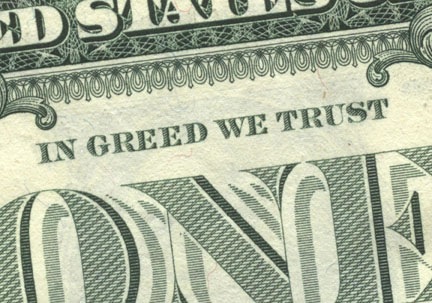
Corporate Greed

greed_trust The Washington Post wrote an interesting article entitled You Can Cap The Pay, But The Greed Will Go On a couple of days ago that confirmed my suspicions about corporate greed and executive compensations. With the current state of the economy, many of us are beginning to question the stability of an unfettered capitalist system. The experiments with communism in the Soviet Union and China have shown that system to be unworkable, but unfortunately, that has been used as an excuse to promote unregulated capitalist markets as the alternative.

I am a strong believer that it is not an either/or argument between capitalism and communism. I believe that economic prosperity can be found somewhere between capitalism and communism. Markets need some regulation to prevent unfair competition and exploitation of workers & resources. Society needs the safety nets of unemployment insurance and health care.

Corporations could act responsibly and for the long term good of both their shareholders and society as a whole if the investors in those companies took a personal interest beyond the short term returns of their investments. We are all guilty of this. Most of us don’t even know what companies we are invested in since most of our savings are in mutual funds and RRSPs.

It is partly this disinterest on the part of investors and the focus on short term profits that got us into the mess that we are currently in. Investors and senior executives seem to only be interested in draining as much profit out of companies as possible.

In 1980, executives at large companies made about 40 times what the average worker made. Last year, CEOs made about 360 times more than the average worker.

I believe that we need to figure out how to make corporations accountable to the people and society as a whole. An excellent example is the Mountain Equipment Co-op, which is owned by the people who shop there, is very successful and socially responsible. I don’t know how we can make more corporations responsible, but I think it is an important area to explore.

If you have ideas, please comment.

2 Responses to “Corporate Greed” »»

  1. Comment by Adam Simpson | 03/23/09 at 9:36 am

    I agree that a balance between the two poles is essential. There’s one statement that requires examination:
    “…if the investors in those companies took a personal interest beyond the short term returns of their investments.”
    There is an interesting corporate culture in the United States. One would think that the owners of a company (shareholders) would benefit from the company’s success by each getting their share of the profits. However, in many large public companies, the profits are paid out to company employees (everyone, not just management and executive) regardless of whether they are shareholders or not and the actual owners or the company receive nothing. This corporate culture is unusual in the wealthiest capitalist nation on earth because the profits are distributed in a very non-capitalist way (capitalism’s fundamental principle is incentive to improve one’s standing in life by creating wealth and reaping the rewards of hard work). Without a guarantee of earning a share of the profits, there is little incentive for the market to trade the stock and increase the share value. The greater consequence is that the employees of the company don’t need to take the risk of owning a stake in the business in order to capitalize on its success because they will still receive a share of the profits.
    This is a small symptom of the reason for America’s financial problems: poor regulation and supervision of business practices. Canada’s financial practices are very well-regulated by the government and central bank system in contrast to those in the U.S. The regulations are in place to prevent the greed machine from running amok. In the U.S., the money machine was allowed to operate well into the red zone. Lehman Brothers and AIG, to name only two of many, were earning money hand over fist by selling what amounts to debt default insurance to other financial institutions. When times were good, there was plenty of money lending between banks and debts were being paid off. Lehman Bros. was selling insurance to other companies covering them for default on the debt they were issuing. The insurance premiums they charged were essentially free money because there was very little debt default taking place. This practice was allowed to carry on, relatively unsupervised by the government. The snowball started rolling when the greed went into overdrive in the sub-prime mortgage market. When all these bad debts started coming home to roost, every financial business that Lehman and AIG had been selling credit default insurance to came knocking at the door. Imagine one in five cars being totalled in collisions in the same month and how this would impact State Farm. There was no way Lehman could pay out that much insurance. And Lehman was insured against debt default by other companies like AIG and AIG was insured by someone else and so on. Someone caught a cold and the whole town ended up dying from the plague.
    Capitalism without proper regulation and supervison is what brought America to its financial knees. The seed for the current crisis, however, is the practice of living beyond one’s means. Yes, the banks brought about their own demise, but credit is so readily available that individual citizens are so convinced they can achieve the American Dream that they don’t stop to ask themselves whether they can afford to. Perhaps it is not rampant capitalism but rather rampant consumerism that is the problem.

  2. Comment by Sharlene | 04/20/09 at 3:09 pm

    Hi Rob,
    Great article and particularly relevant. Have you and Juliette seen the film “The Corporation?” It asks similar questions. I was so impressed I’ve been meaning to order a copy. Documentary filmmakers rarely break even with their work, and their film deserves to be widely viewed.
    One solution lies in amending a corporation’s charter to include environmental and social responsibility mandates. People and organizations are great at doing what they’re incented to do. I’m astonished by the findings of the Milgram experiment and more personal examples of good people doing bad things when they’re incented to do so. Fortunately people and organizations can respond remarkably quickly when conditions change – figuring out where the levers are and how to change the way they’re incented is key. Simple things like a global carbon tax (instead of a cap-and-trade system) could work miracles.

    Cheers, Sharlene

Leave a Reply »»